# Seize It With Both Hands
Taper is an online literary journal for computational poetry and literary art published twice yearly by Bad Quarto.
My piece Seize It With Both Hands is published in Taper#14: Sonnets.
# 1 Description
Latin squares of order N have N copies each of N symbols arranged in an N by N grid, such that each symbol occurs exactly once in each row and exactly once in each column. An example of order 3 is
A   B   C
B   C   A
C   A   B
Two Latin squares S and T of the same order are called orthogonal if when pairing grid cells at the same position, each possible ordered pair of symbols occurs exactly once. The mathematician Leonard Euler called them Graeco-Latin squares, using Greek letters for one square and Latin letters for the other. An example of order 3 is.
Aα  Bγ  Cβ
Bβ  Cα  Aγ
Cγ  Aβ  Bα
The thirty-six officers problem
… revolves around arranging 36 officers to be drawn from 6 different regiments so that they are ranged in a square so that in each line (both horizontal and vertical) there are 6 officers of different ranks and different regiments. — Leonhard Euler [0]
It was not until the 1950s that it was proven that Graeco-Latin squares can be constructed for every order N apart from N = 2 and N = 6.
A set of Latin squares of the same order such that every pair of squares are orthogonal (that is, form a Graeco-Latin square) is called a set of mutually orthogonal Latin squares. — Wikipedia [1].
A set of 4 mutually orthogonal Latin squares of order 5 is presented ibid as an HTML table using the four alphabets of background colour, foreground colour, typeface and text.
In [2], an example set of 4 mutually orthogonal Latin squares of order 14 is presented, in compressed form as a difference matrix. The difference matrix expands to an orthogonal array, which is equivalent to the set of mutually orthogonal Latin squares.
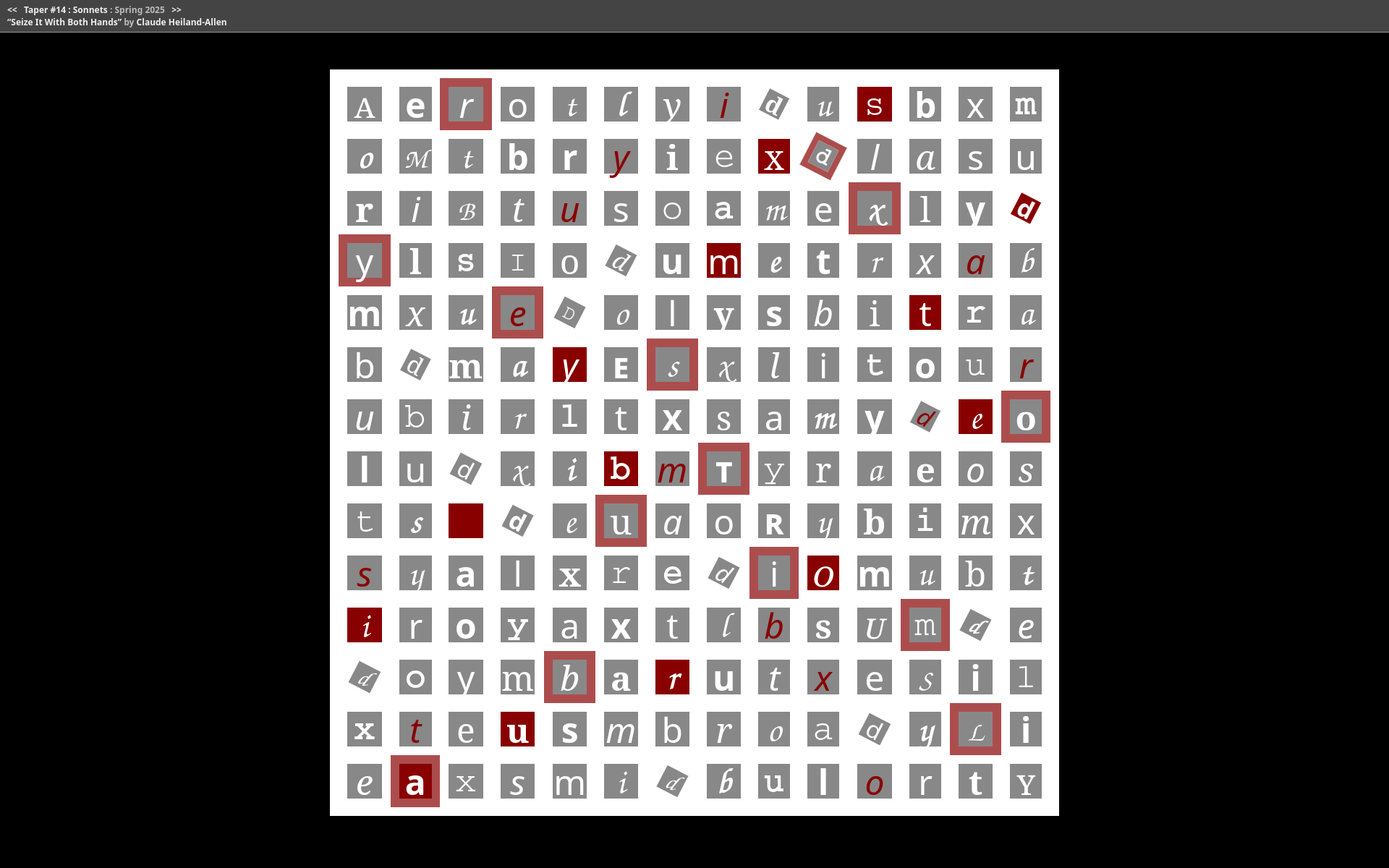
The page you are reading presents the mutually orthogonal Latin squares from [2] using the six alphabets of background colour, foreground colour, border colour, typeface, rotation, and text (some of the Latin squares have multiple alphabets assigned). The text is formed from the characters of a 14 letter word with no repeating letters [3].
The presentation is split temporally, to avoid an information overload. The lengths of each of the individual looping component animations are chosen so that the whole cycle repeats after exactly 2 weeks (a fortnight of 14 days).
[0] Euler, L. (written 1779, published 1782), Recherches
sur une nouvelle espece de quarres magiques, quoted by Wikipedia
(accessed 2025-01-02), https://en.wikipedia.org/wiki/Mutually_orthogonal_Latin_squares#Thirty-six_officers_problem
[1] Wikipedia (accessed 2025-01-02), Examples of
mutually orthogonal Latin squares, https://en.wikipedia.org/wiki/Mutually_orthogonal_Latin_squares#Examples_of_mutually_orthogonal_Latin_squares_(MOLS)
[2] Todorov, D.T. (2012), Four Mutually Orthogonal Latin
Squares of Order 14. J Combin Designs, 20: 363-367. https://doi.org/10.1002/jcd.21298
[3] Unscramblerer.com (accessed 2025-01-02), 14 letter
words with no repeating letters. https://www.unscramblerer.com/14-letter-words-with-no-repeating-letters/
# 2 Implementation
The source code begins with the table taken from [2], followed by code to decompress it into the 4 grids. Between writing the code in early 2025 and writing this description in mid 2026 I forgot how it works.
The grids are converted to HTML with different combinations of letters and CSS styles for each cell. The styles are animated using CSS animations: once the page is constructed there is no more Javascript running.
# 3 Screenshot
Static snapshot for archival purposes only: